
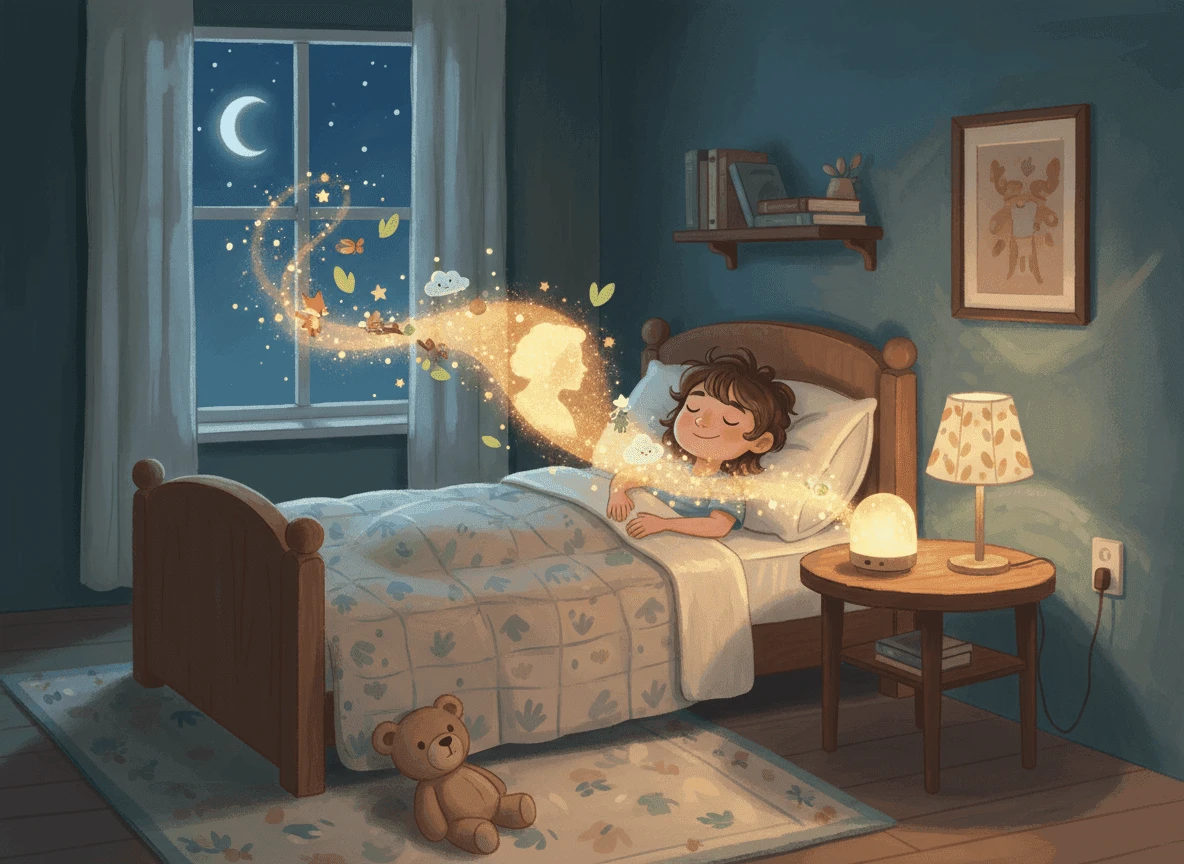
A bedtime story for a three-year-old has a different job from the books they look at in the afternoon. It isn't there to teach them something or to keep them on the edge of their seat. It's there to close the day, slowly enough that your child goes along with it.
The stories that do this well have a lot in common. They're short, they repeat themselves, the problem is small, and they end with someone in bed. Below is what works at this age and why, five short stories you can read tonight, and a simple template for making up your own.
| What works | Why it helps | What it looks like |
|---|---|---|
| 2 to 5 minutes long | A tired preschooler's attention runs out fast. A short story finishes before the wriggling starts. | 200 to 400 words, about a page |
| One character, one small problem | Children this age follow one thread. A second plot line loses them. | A bunny who can't find her blanket |
| Repetition | Repeated lines let children guess what comes next, and joining in is half the fun. It also slows your reading down. | "Not here," said Bunny. "Not here." |
| Familiar places | Home, the garden, the park and bed feel safe at night. Faraway lands can wait for daytime. | A kitchen at night, a garden in the rain |
| A problem solved in a small way | Big danger wakes children up. Small worries match the ones they actually have. | Being too small, missing something, a noise in the dark |
| An ending that gets quieter | The story should wind down the way the day does, ideally with someone falling asleep. | Short, slow, soft last lines |
| Your child's name, or their toy | Children listen harder for their own name, and their own teddy as the hero makes the story theirs. | "And Mr. Button said goodnight to Maya" |
What tends not to work at bedtime: cliffhangers, villains, chases, big jokes in the last minute, and a moral spelled out at the end. "What happens next?" is the opposite of the question you want at lights out, and a story about sharing makes its point without being told to.
Each takes two to three minutes read slowly. They get calmer as they go, so read the last few lines softer than the first. Swap in your child's name or a favorite toy wherever you like.
About 2 minutes · good for joining in
Little Bunny was ready for bed. Teeth brushed. Paws washed. But where was her blanket?
She looked under the bed. "Not here," said Little Bunny.
She looked behind the door. "Not here," said Little Bunny.
She looked in the toy box, under the books and inside her slippers. "Not here, not here, not here."
Mama Bunny came in with a cup of warm milk. "Let's think," she said. "Where did you have it last?"
Little Bunny thought. She'd had it at lunch. She'd had it in the garden. She'd had it on the window seat, watching the rain.
The window seat! There was her blanket, curled up in a soft heap, still warm from the last bit of sun.
Little Bunny carried it back to bed and pulled it up to her chin. It smelled like sunshine and rain.
"Found you," she whispered. And she closed her eyes.
About 2 minutes · slow the "chuff" down each time
The last train of the night goes chuff, chuff, chuff along the hill. It's a little train, and it's full of sleepy animals.
At the first stop, by the field, the train slows down. Chuff... chuff... The cows climb off and lie down in the soft grass. "Goodnight, train," they say.
At the second stop, by the pond, the ducks step off and tuck their heads under their wings. "Goodnight, train."
At the third stop, by the woods, the fox hops off and curls her tail around her nose. "Goodnight, train."
Now there's only one passenger left: a small bear in pajamas, holding a teddy.
The train goes slower. Chuff... chuff... chuff. It stops outside a little house with one light on in the window.
The bear climbs off, walks up the path and gets into bed. The light goes off.
And the little train? It rolls into its shed, lets out one long, soft sigh, shhhhhh, and goes to sleep too.
About 3 minutes · for children who are tired of being the littlest
Nell was the smallest mouse in the house. Too small to reach the cheese on the table. Too small to see out of the window. Too small, said her big brothers, to stay up late.
"I'm not too small for everything," said Nell. But she went and sat on the bottom stair, feeling very small indeed.
Then Grandpa Mouse called from the kitchen. "Oh dear. My glasses have rolled under the cupboard, and the gap is so narrow. Is anyone small enough to fit?"
Nell stood up. She squeezed under the cupboard, past the crumbs and the dust, and there were Grandpa's glasses, shining in the dark.
She pushed them out with her nose. "Here they are!"
Grandpa put them on and smiled at her. "Just the right size," he said, "for exactly that."
That night Nell went to bed at the same time as always. But she didn't feel small. She felt just the right size. She gave a just-right-size yawn, snuggled down, and fell fast asleep.
About 2 minutes · for children who hear things after lights out
Theo was in bed when he heard it. Tap. Tap-tap.
"What's that?" he whispered to his dinosaur.
The dinosaur didn't know.
Tap. Tap-tap.
Theo held the dinosaur tight and climbed out of bed. He tiptoed to the window and peeked behind the curtain.
It was the rain. Little drops were landing on the glass, tap, tap-tap, and sliding down like children on a slide.
"It's only rain," Theo told the dinosaur. "It's saying hello."
He got back into bed and listened. Tap. Tap-tap. It didn't sound scary anymore. It sounded like someone drumming very, very softly.
Tap... tap-tap...
Tap...
Theo was asleep before the rain stopped.
As long as you like · your child helps tell it
You tell the frame, and your child chooses who goes to sleep next. After three or four turns, stop asking and finish it yourself, quietly.
When the sun goes down, the garden gets ready for bed.
The snail slides into his shell. "Goodnight," says the snail.
The bee flies home to the hive. "Goodnight," says the bee.
The flowers fold up their petals. "Goodnight," say the flowers.
Now ask: who goes to sleep next in the garden? A worm, a hedgehog, the swing, the bird bath? Let your child choose, then say how it settles down and add its "Goodnight." Do this two or three times, then carry on:
Now the whole garden is asleep. The grass is still. The swing doesn't swing. Only the stars are awake, keeping watch.
And inside the house, at the top of the stairs, someone small is getting sleepy too. "Goodnight, garden," they whisper. "Goodnight."
When you've read these a dozen times (you will), this template gives you a new one in a minute. Fill one line at a time, out loud.
| Line | Fill in | Example |
|---|---|---|
| 1. Who and where | A character in a cozy place, getting ready for bed | Little Owl, in her tree, at the end of the day |
| 2. A small problem | Something lost, a worry, too small, too noisy | The wind is so loud she can't sleep |
| 3. Three tries | The same kind of try, three times, with a line that repeats | She counts stars: one, two, three. Still awake. She counts leaves. Still awake. She counts clouds. Still awake. |
| 4. A gentle fix | Kindness, patience, a helper, or finding the thing | Mama Owl says the wind is only singing, and hums along with it |
| 5. A sleepy ending | The character lies down and closes their eyes | Little Owl tucks her head under her wing, and the wind sings her to sleep |
Three tries matter more than they look. They give the story its rhythm, they're easy for your child to predict, and by the third one their eyes are usually heavy. For more starting points, see 7 bedtime story prompts that actually work. For daytime stories with a bit more adventure, try the five-part story builder.
At three, children often want the same story every night for weeks. That's fine. Knowing what comes next is comforting at the end of the day. Keep stories under three minutes, lean on repetition, and let them say the repeated line with you.
At four, children want a say. Let them pick the character or the problem, and expect to be corrected if you change a word in a story they know.
At five, they can follow a slightly longer story with a small surprise in it, and many love a character who comes back night after night. A little series ("another Nell story, please") gives them something to look forward to at bedtime. Some five-year-olds start to call stories "for babies", so let them choose.
For what to expect from reading itself at each age, see reading milestones by age.
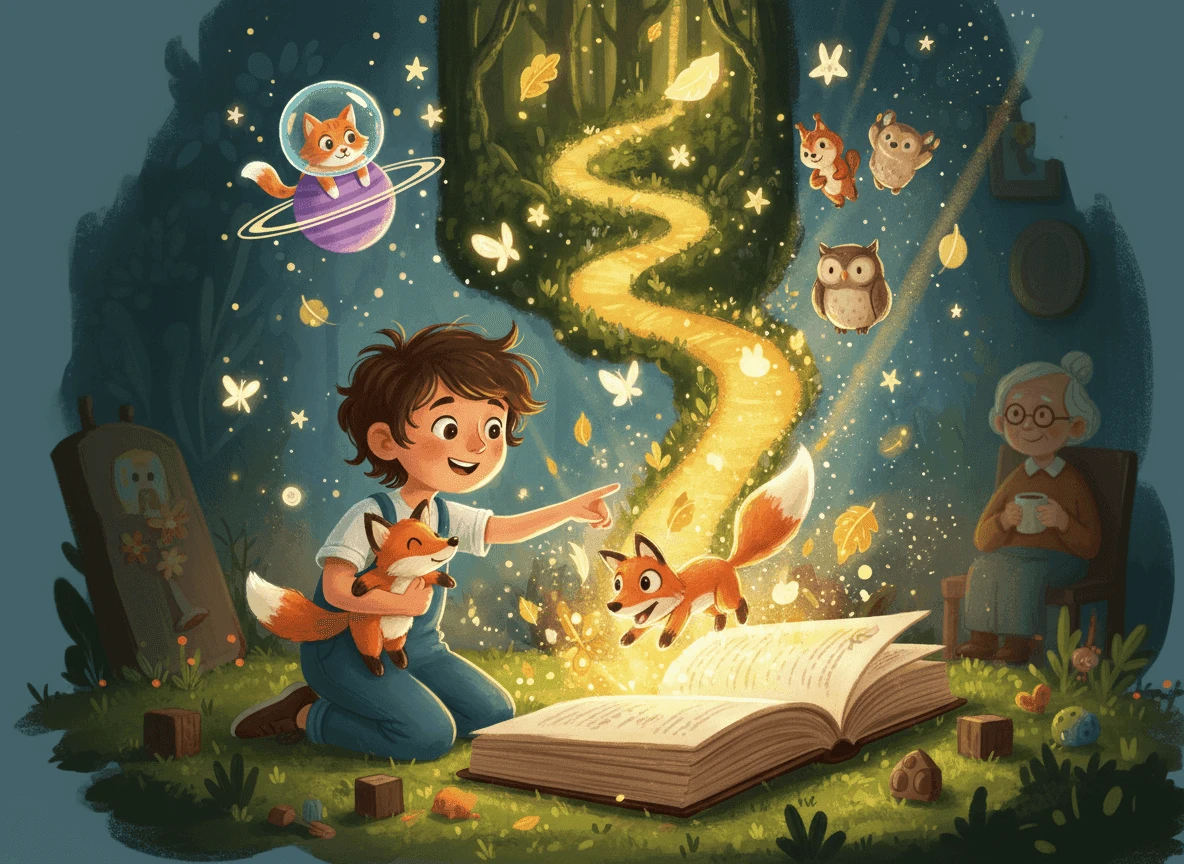
If you run out of stories, StoryBee makes personalized bedtime stories in about a minute. Choose the 2–4 age group for a three-year-old or 4–6 for a four or five-year-old, and describe the story in a sentence using the same ingredients as above:
"A short, calm bedtime story about Maya, age 3, and her teddy Mr. Button. Mr. Button can't find his hat. They look in three places and find it under Maya's pillow. End with them both falling asleep."
StoryBee writes the story at your child's level and illustrates it. Add your child as a Story Character so the pictures look like them. If you'd like a night off from reading aloud, record your voice once and StoryBee can narrate any story in it. The StoryBee Listen app plays narrated stories with the screen off, so there's no glowing tablet in the bedroom.
You can also browse calm bedtime stories other families have made. In December, the Christmas countdown has 24 one-minute stories that suit this age.
How long should a bedtime story be for a 3 year old? Two to five minutes read aloud, which is about 200 to 400 words. A short story you finish beats a long one you abandon halfway through.
Why does my child want the same bedtime story every night? Knowing what comes next feels safe at the end of the day, and hearing the same words again helps young children learn them. Go with it, and add new stories alongside the favorite rather than instead of it.
Should a bedtime story have a lesson? It can, but let the story carry it. A character who is kind or brave in a small way says enough. Spelling out the moral at the end tends to start a conversation when you want sleep.
What if a bedtime story scares my child? Stop, reassure them, and switch to a story they know. At this age, skip villains, getting lost and the dark as something dangerous. If a fear keeps coming up, a story where the scary thing turns out to be ordinary, like the rain in "The Noise in the Night", can help.
Are there free short bedtime stories for preschoolers? All five stories in this article are free to read at home, and so are the stories StoryBee families share: browse bedtime stories for 3-year-olds, for 4-year-olds and for 5-year-olds. Signing up for StoryBee is free too, and verifying your email gives you 2 free illustrated stories. After that, making new stories is on paid plans.

Let’s explore the magical world of bedtime stories and discover why they are so important for our children.
Read more
24 original Christmas bedtime stories for kids, one for every night from December 1 to Christmas Eve. Each takes about a minute to read aloud, for ages 3 to 8, with a prompt to make your child the hero.
Read more
Five original short Christmas stories for kids, each about two minutes read aloud. Gentle Santa, elf, and snow stories for ages 3 to 8, with a question to talk about after each one.
Read more