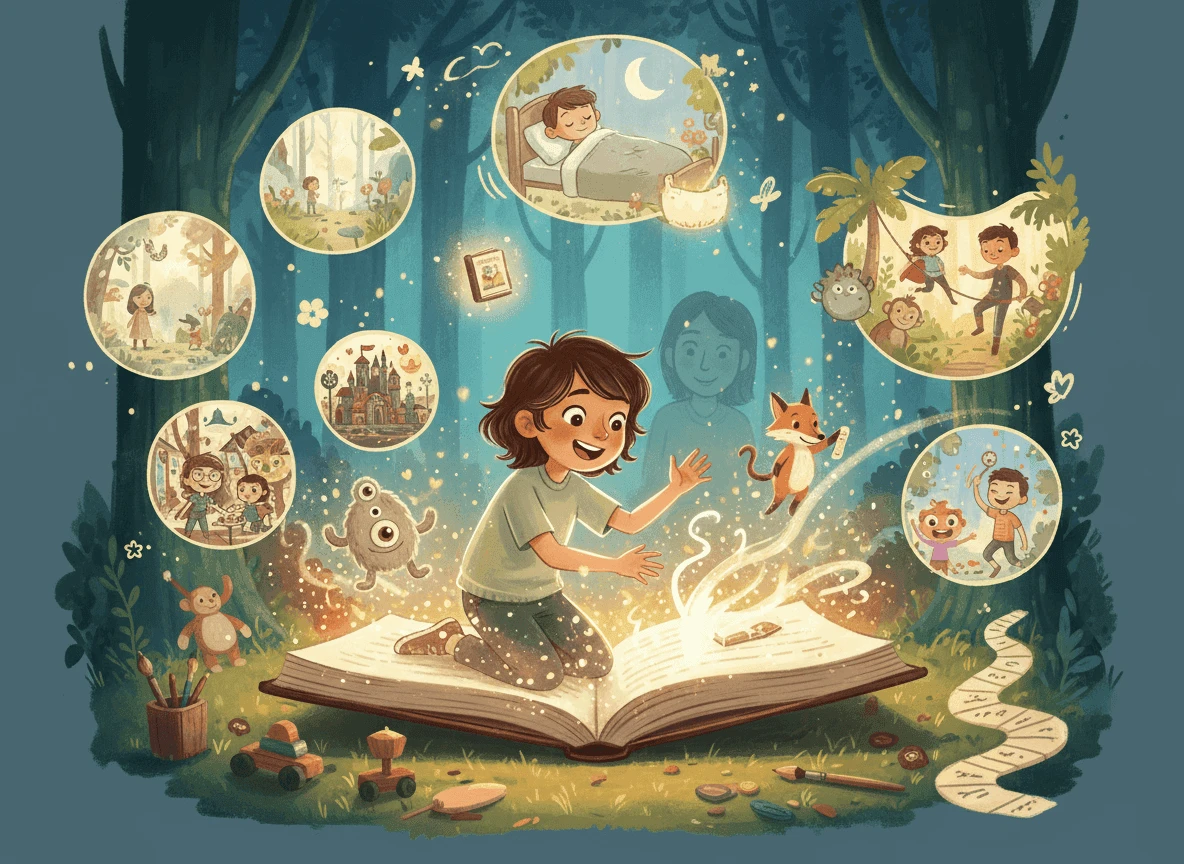
Kids care more about a story they helped make than one they're handed. The hard part is the blank start, when you say "let's make up a story" and both of you stare at the ceiling.
What helps is a shape to hang the story on. The one below has five parts. Ask your child one question per part, write down what they say, and you have a complete story with a beginning, a middle and an end. Most four-year-olds can answer the questions out loud, and older kids can fill it in on their own.
| Part | Ask your child | Example answer |
|---|---|---|
| 1. Hero | Who is the story about? | Zara, who is six and loves bugs |
| 2. Wish | What do they want more than anything? | To find the glowing beetle her grandpa told her about |
| 3. Problem | What gets in the way? | The beetle only comes out at night, and Zara is scared of the dark |
| 4. Two tries | What do they try first? What do they try next? | She shines a flashlight, but it scares the beetle away. Then she sits in the dark and waits. |
| 5. Ending | How does it end, and how do they feel? | The beetle lands on her hand, and the dark doesn't feel scary anymore |
A few notes on each part:
If your child gets stuck on a part, offer two choices instead of an open question. "Is the problem that it's too high, or that someone else wants it too?" is much easier to answer than "What's the problem?"
Here's the table above turned into a story. Reading one back to your child, in full sentences, is the moment they see that their answers became a real story.
Zara was six, and she loved bugs more than anything. She kept a notebook of every beetle she had ever found.
One evening Grandpa told her about the glowing beetle. "It lives at the bottom of the garden," he said, "and it shines like a tiny star." Zara wanted to see it more than she had ever wanted anything.
But the glowing beetle only came out at night, and Zara was scared of the dark.
The next night she took a flashlight and waved it all over the garden. Nothing glowed. The beetle didn't like the bright light, and it stayed hidden.
So the night after that, Zara tried something braver. She sat on the bottom step with the flashlight switched off and waited. The dark was big and quiet. She counted her breaths.
Then, near the roses, a tiny green light blinked. It flew closer and closer, and landed right on Zara's hand.
She sat very still and smiled. The dark didn't feel scary anymore. It felt like the place where the glowing beetle lived.
Roll a die three times, or let your child pick a number, and use one line from each table. It turns "I don't know" into a game.
| Roll | Hero | Place | Problem |
|---|---|---|---|
| 1 | A dragon who can't breathe fire | A city under the sea | Something important has gone missing |
| 2 | A girl who can talk to birds | A school on the moon | A friend is stuck and needs help |
| 3 | A very small robot | Grandma's house | Someone keeps breaking the rules |
| 4 | A dog who wants to be a chef | A jungle at night | A storm is coming |
| 5 | Your child | A castle made of books | The hero has to be brave about a fear |
| 6 | A worried cloud | The back of a school bus | Two friends want the same thing |
A roll of 4, 2 and 6 gives you a dog who wants to be a chef, at a school on the moon, where two friends want the same thing. Now go through the five parts with that.
For ages 2 to 4, you do most of the telling. Let your child choose the hero and one thing about them, and ask simple either-or questions for the rest.
From 4 to 6, children can answer all five questions out loud. Write their answers down word for word, even the odd ones. Seeing their exact words in the story is the best part.
From 6 to 10, they can dictate or write the story themselves. Add a second problem in the middle to stretch it, and ask them to name how the hero feels at each part.
From 10 to 13, hand over the table and be the editor. Ask one question per part, like "Why does the problem matter to her?", instead of fixing their sentences.
Once you have the five answers, you can turn them into a finished, illustrated story with StoryBee's AI story maker for kids. Put the answers into one prompt:
"A story about Zara, age 6, who loves bugs. She wants to find a glowing beetle her grandpa told her about, but it only comes out at night and she's scared of the dark. Her flashlight scares it away, so she sits in the dark and waits. It ends with the beetle landing on her hand and Zara feeling brave."
Choose your child's age group and a genre, and StoryBee writes the story and draws the pictures. Read it together and compare it with your own version. Kids enjoy spotting what the story maker kept and what it changed, and arguing about which version is better.
If your child is the hero, you can add a Story Character from a photo so the pictures look like them.
How do you make a story for kids? Give it five parts: a hero, something the hero wants, a problem in the way, two tries to solve it, and an ending that answers the wish. Ask your child one question for each part and write down the answers.
What if my child can't think of anything? Offer two choices instead of an open question, or roll the story dice above. Starting from a real object in the room also helps.
How long should a story we make together be? Short enough to finish in one sitting. A story you finish beats a long one you abandon, and you can always make a sequel tomorrow.
Can we turn our story into a book? Yes. On StoryBee you can generate an illustrated version, save it to your library, and download it as a PDF. Printed books are coming soon.
Is there a free story maker for kids? The story builder in this article is free: all you need is a pencil. Signing up for StoryBee is free too, and generating illustrated stories is on paid plans.
For more starting points, see 50 story prompts for kids, how to write a story prompt with the SCRL method, and creative writing activities for kids.

Story endings, prediction pauses, and reflection prompts can turn the last five minutes of class into real comprehension checks without the groans.
Read more
Five original short Christmas stories for kids, each about two minutes read aloud. Gentle Santa, elf, and snow stories for ages 3 to 8, with a question to talk about after each one.
Read more
StoryBee Story Characters lets children become the hero of their own stories. Create personalized AI stories with child characters, photos, interests, and recurring adventures.
Read more