
Every fridge has one. A purple monster with five legs, a house with the sun squeezed into one corner, a family where the dog is bigger than everyone else. Ask your child about it and there's nearly always a story behind it, one they made up while they were drawing.
This guide shows how to get that story out of them, and then two ways to turn it into a book: by hand with paper and a stapler, or with StoryBee from a photo in a few minutes. Start with the questions either way. They do most of the work.
Say "Tell me about your picture" rather than "What is it?" If you guess and get it wrong ("Is that a horse?" "It's Grandma!"), the conversation usually ends there. Then work through these questions, one at a time.
| Ask | What it gives you |
|---|---|
| Who is this? What's their name? | The hero |
| What are they doing right now? | The opening scene |
| Where are they? | The setting |
| What do they want? | What the story is about |
| What goes wrong? | The problem |
| Who helps them? | A second character |
| How does it end? | The ending |
Write the answers down in your child's exact words, even the odd ones. "He's sad because his legs are too many" is better than anything you'd write yourself, and children notice when their words make it into the story.
Scribbles count too. A two-year-old's tangle of lines might be "a dragon going to the shops", and that's a whole story.
Leo, who is five, drew a purple blob with five legs and one tooth. Here's what he said when his mom asked the questions:
Now line the answers up: who, where and what they want first, then the problem and how they try to fix it, then the ending. Read it back to your child in full sentences. This is the moment they realize their drawing has become a real story.
Gloop was a purple monster with five legs and one tooth, and he lived under the kitchen sink.
Every day he looked out of the window at the park. He wanted to go more than anything. But Gloop had a problem. Five legs was too many for walking, and every time he tried, he wobbled and fell over.
One morning a spider came down on a thread. "Too many legs?" said the spider. "I've got eight. Watch me." She showed Gloop how to move his legs one at a time, left, right, left, right, left.
Gloop practiced all day. By the evening he could walk all the way to the back door.
The next day he walked to the park, climbed the big slide and whooshed down. He didn't wobble once.
Keep it short. Five or six sentences is plenty for a child under six, and you can always make a sequel when the next drawing arrives.
This costs nothing and makes a book your child can hold.
If your child already has a pile of drawings, try it the other way round. Lay four to six of them on the floor, ask which comes first, and make up the story that joins them. The rocket, the cat and the birthday cake can absolutely be the same adventure.
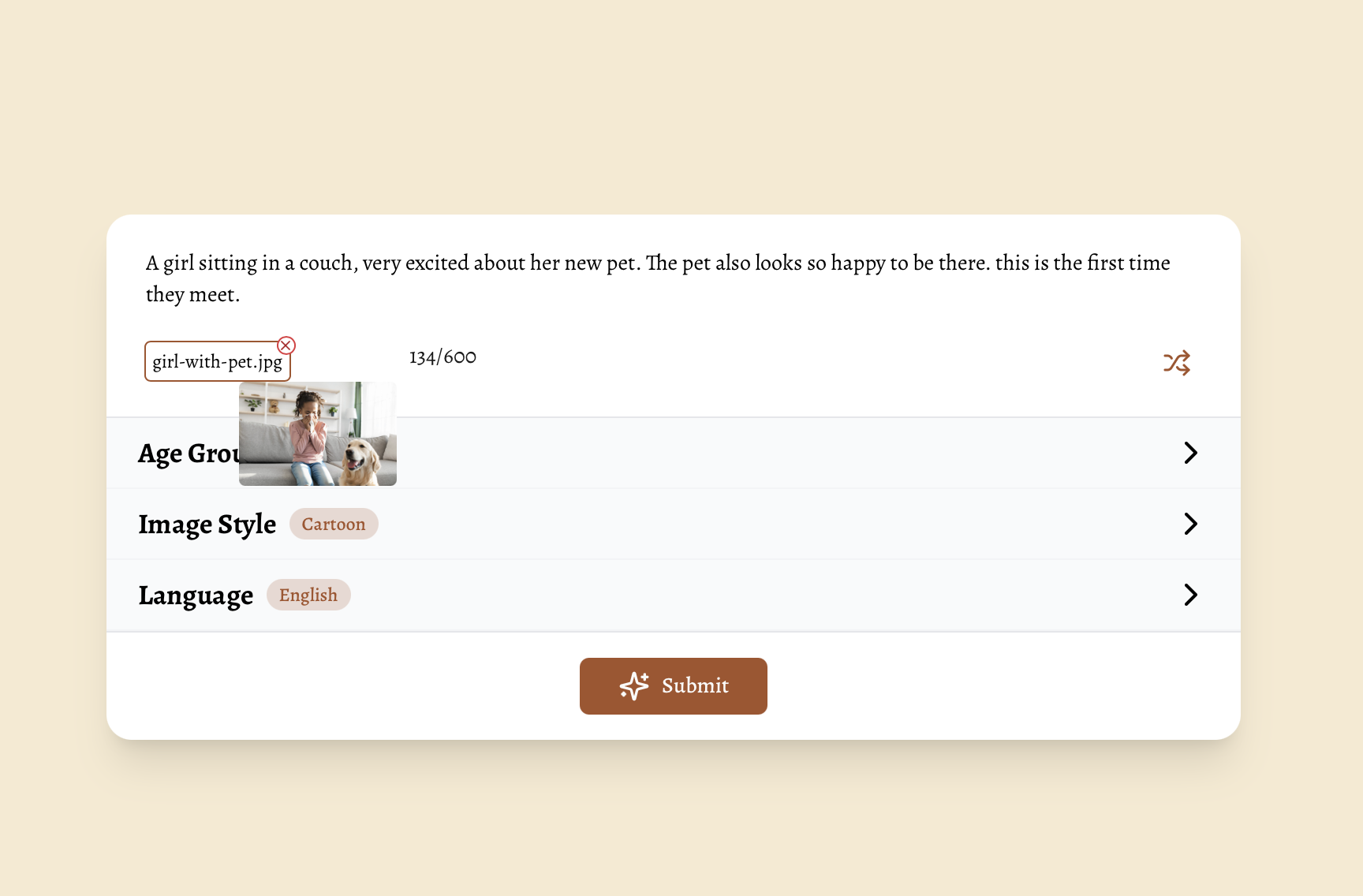
If you'd like a finished, illustrated story that reads itself aloud, StoryBee's drawing-to-story feature builds one around a photo of the drawing.
Here's the description Leo's mom wrote for Gloop:
"Gloop is a purple monster with five legs and one tooth who lives under the kitchen sink. He wants to go to the park but he's too wobbly to walk. A friendly spider teaches him to move one leg at a time. It ends with Gloop going down the big slide, not wobbly at all. Make it funny and gentle."
A few things make the description work:
The illustrations are drawn in the image style you choose, so Gloop may come back looking a little different from the original. Put the drawing next to the screen and let your child point out what stayed the same. They usually have strong opinions about it. For more help with each step, see the Visual Stories guide.
Ages 2 to 3. You do the asking and most of the telling. Ask who it is and what they're doing, offer two choices for the rest ("Is he going to the park or the beach?"), and keep the story to a few sentences.
Ages 4 to 5. Most can answer all seven questions out loud. Write down their exact words and read them back, and let them draw the extra pages for the paper book.
Ages 6 to 8. They can write the words themselves, or dictate while you write. Ask them to add one more try before the problem gets solved, which makes the middle more interesting. The five-part story builder works well at this age.
Ages 9 and up. Try it as a comic. They draw six boxes first, one for each part of the story, then add captions and speech bubbles. For more ideas, see creative writing activities for kids.
How do I turn my child's drawing into a book? Ask your child about the drawing, write the story in their words, then either make a paper book (three sheets folded and stapled, with one part of the story per page) or upload a photo of the drawing to StoryBee for an illustrated story you can share and add narration to.
Does it work with scribbles? Yes. Ask your child what it is and use their answer. The story comes as much from what they tell you as from the picture.
Is turning a drawing into a story free? The paper book is free. Signing up for StoryBee is free too, but Visual Stories from drawings and photos need an active paid plan. See pricing for what each plan includes.
Is my child's drawing kept private on StoryBee? Yes. Your uploads and stories are private to your account, you choose what to share, and you can delete them at any time.
Can I get a printed copy of the story? A StoryBee Visual Story is an illustrated story you read on screen and share as a link, with narration on plans that include audio. Printed StoryBee books are coming soon. Until then, the paper book in step 3 is the one to keep on the shelf.

A five-part story builder for making up a story with your child: a hero, a wish, a problem, two tries, and an ending. With a fill-in table, a worked example, dice tables for when you're stuck, and how to turn it into an illustrated story.
Read more
A short bedtime story ritual can help parents end the night without the usual battles. One prompt, a simple structure, and a little child input are usually enough.
Read more
You want to spark imagination and strengthen bonds. You need a way for parents, teachers, and children to build stories together. AI can help you guide creativity. It can capture every idea and turn it into a polished draft in minutes
Read more