
26 Mar 2026
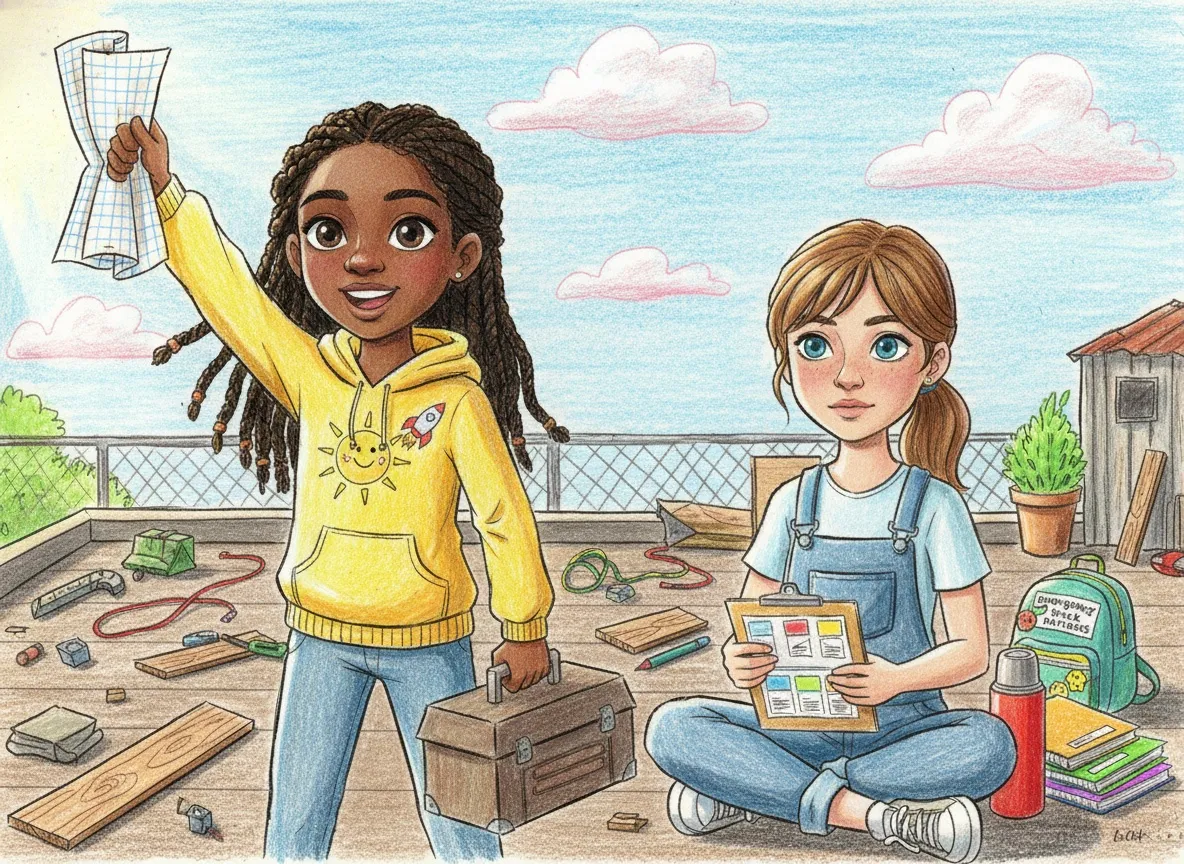
Aisha zipped up her bright yellow hoodie. The wind whipped her dark, braided hair across her face. Today was the day! Armed with a large, slightly crumpled blueprint drawn on graph paper, she clutched a worn toolbox. Her best friend, Lena, followed close behind, expertly balancing a stack of notebooks and a red thermos of apple juice. They were on a special mission: to build Aisha’s very first weather station on the school rooftop.
“Are you sure we have everything, Lena?” Aisha asked, her voice buzzing with excitement. They pushed open the heavy door leading to the roof. A burst of fresh air greeted them. The rooftop was a flat, open space, perfect for their scientific endeavors. A low fence ran along the edge, and in one corner, a small, unused shed sat quietly.
Lena consulted her clip-board, a serious expression on her face. “Let’s see… anemometer parts, check! Rain gauge assembly, check! Thermometer, check! Extra pencils, ruler, magnifying glass for tiny observations, double-check! And of course,” she winked, “emergency snack rations!” She patted a small backpack.
Aisha grinned. Lena was the best helper a budding scientist could ask for. Aisha, with her boundless curiosity and patience, often plunged headfirst into projects. Lena, on the other hand, was the master of organization, making sure no detail was overlooked.
They found a clear spot near the center of the rooftop, away from any tall vents or pipes that might block the wind or rain. Aisha carefully unrolled her blueprint. It was an elaborate drawing, showing where each weather instrument would go. She had spent weeks poring over books and online videos, learning about meteorology – the science of weather.
“First, the anemometer!” Aisha declared, pulling out a bag of plastic cups, a wooden dowel, and a small metal rod. “This is how we measure wind speed, Lena. The wind catches the cups and makes them spin. The faster they spin, the faster the wind is blowing!”
Lena’s eyes widened. “Like a tiny Ferris wheel for the wind!”
“Exactly!” Aisha laughed. They worked together, Aisha explaining each step, and Lena diligently sorting the screws and helping to hold pieces steady. They punched holes in the plastic cups, then attached them to the ends of crossbars made from the wooden dowel. Getting the cups perfectly balanced was tricky. Their first attempt resulted in a wobbly, unbalanced contraption that spun unevenly.
“Whoa, that’s not right,” Lena observed, giggling as one cup dipped much lower than the others.
Aisha squinted at her blueprint. “Hmm, the center point isn’t quite right. And maybe the holes aren’t all the same distance from the middle.” She carefully measured again, making tiny adjustments. This time, when they spun it, the cups twirled smoothly. Aisha then attached the spinning cups to the metal rod, which would rest in a small, oiled bearing to reduce friction. “See? Less friction means it spins more freely, giving us a more accurate reading!”
Next came the rain gauge. Aisha pulled out a large, clear plastic bottle they had cut in half. “This is simpler,” she explained. “We just need to make sure the opening is wide enough to catch the rain, but not so wide that it evaporates too quickly.” She showed Lena how they would measure the collected rainwater using a ruler marked with tiny milliliter lines. They placed a smaller, narrower bottle inside the larger one to make the readings more precise. “The narrower bottle makes it easier to see small amounts of rain,” Aisha pointed out, “like a magnifying glass for water.”
Scientific discovery is a journey of curiosity, patience, and learning from mistakes. With perseverance and clever thinking, even setbacks can lead to better solutions and deeper understanding.
Story theme is Scientific observation, problem-solving, friendship, perseverance, meteorology
Originally published on StoryBee. © 2026 StoryBee Inc. All rights reserved.
0 likes
While Aisha secured the rain gauge to a sturdy post they had brought, Lena carefully labeled a section in her notebook: “Rainfall Data.” She meticulously drew columns for ‘Date,’ ‘Time,’ and ‘Amount (mm).’ Her handwriting was neat, a stark contrast to Aisha’s quick, sometimes scrawled notes.
Finally, the thermometer. Aisha produced a simple, liquid-in-glass thermometer. “This one’s easy to use, but we need to make sure it’s in the shade,” she instructed. “If the sun shines directly on it, it will heat up and give us a wrong temperature reading.” They found a spot on the north side of the small shed, where it would be shielded from direct sunlight for most of the day. Aisha carefully hung it, making sure it was at eye level.
By lunchtime, their little weather station was complete. The anemometer stood tall, ready to dance with the wind. The rain gauge promised to catch every precious drop. The thermometer patiently waited to measure the air’s warmth or coolness. They sat down, munching on Lena’s homemade peanut butter sandwiches and sipping apple juice, admiring their handiwork.
“It looks amazing, Aisha!” Lena exclaimed, her eyes sparkling. “Now what?”
“Now, we observe!” Aisha declared, her voice filled with a scientist’s gravity. “Science isn’t just about building things, Lena. It’s about watching, recording, and understanding what happens.”
Their first week of observations was an adventure. Every morning and every afternoon, they climbed to the rooftop. Aisha meticulously read the thermometer, noting the degrees Celsius. Lena, with her organized mind, dutifully recorded the numbers in her notebook, creating neat tables.
The anemometer proved to be the most exciting. One blustery Tuesday, the plastic cups spun so fast they were a blur. “Wow! Look at it go!” Aisha shouted over the wind’s roar. “The wind must be really strong today!” Using a stopwatch, they timed how many rotations the anemometer made in one minute. Aisha had made a simple chart connecting rotations to estimated wind speed. She knew it wasn’t perfectly accurate without a calibrated sensor, but it gave them a good idea.
“Thirty-five rotations in one minute!” Lena announced, her pen scratching quickly. “That’s, let’s see… medium-strong wind!”
Then came the rain. A sudden afternoon thunderstorm rolled in, drenching the city. From below, through the classroom window, they watched the downpour. As soon as it lessened, they raced to the roof, umbrellas in hand. The rain gauge had collected a surprising amount of water. “Look, Lena! Almost ten millimeters!” Aisha exclaimed, carefully lowering her ruler into the narrow bottle. “That’s a lot for just an hour!”
Lena dutifully logged the data. “The sky looked really dark before it started,” she observed. “Do you think the darkness means more rain?”
Aisha pondered this. “That’s a great question, Lena! We’ll have to keep observing. Maybe there’s a pattern!” This was the heart of science: asking questions and then looking for answers through careful observation.
They started noticing other things too. On sunny days, the temperature rose steadily. On cloudy days, it stayed cooler. When the wind blew from the west, they often felt a different kind of chill than when it blew from the north. Aisha even rigged a simple wind vane using a piece of cardboard shaped like an arrow and a pencil, so they could tell the wind’s direction.
One afternoon, Aisha noticed something peculiar. The temperature reading was much higher than she expected for an overcast day. She checked her thermometer; it was still in the shade. She looked around. A large, dark-colored air vent on the roof was blowing out warm air, and the wind was carrying some of that warmth towards their thermometer.
“Aha!” Aisha exclaimed, snapping her fingers. “The exhaust vent! It’s making our temperature sensor think it’s hotter than it really is.”
Lena frowned. “So our data is wrong?”
“Not wrong, just influenced by a local factor,” Aisha explained. “It means we need to move the thermometer to an even better spot, or note down that the vent might be affecting the data. This is what scientists call controlling variables! We want to measure just the air temperature, not the air temperature plus extra heat from a vent.” They carefully relocated the thermometer to a corner of the roof furthest from any vents, where it could get a truer reading of the general air temperature.
The days turned into weeks. Aisha’s notebook filled with numbers and her quick sketches of cloud types – fluffy cumulus, wispy cirrus, flat stratus. Lena’s meticulously organized tables grew longer, charting the daily temperatures, wind speeds, and rainfall. They started making predictions.
“I think it’s going to rain tomorrow,” Aisha declared one evening, pointing to a gathering of dark, lumpy clouds moving in from the west. “Our wind data from today shows a shift, and those clouds look like nimbostratus – rain-bearing clouds!”
“And the temperature dropped a few degrees this afternoon,” Lena added. “That often happens before rain, doesn’t it?”
The next morning, they rushed to the roof. Sure enough, the rain gauge held a steady amount of fresh rainwater. Their prediction had been correct! A triumphant cheer erupted from them. It was a thrilling moment – seeing their observations transform into genuine scientific predictions.
Their weather station became a source of endless fascination. They learned about the water cycle, watching evaporation after a rain shower, and how clouds formed. They discussed air pressure, even though they didn't have a barometer, understanding that changes in pressure often brought changes in weather.
One sunny day, a strong gust of wind suddenly tore through the rooftop, catching their anemometer with surprising force. With a loud CRACK, the wooden dowel that held the cups snapped. The plastic cups went tumbling across the roof, bouncing and skittering until they bumped against the safety fence.
Aisha's face fell. “Oh no! My anemometer!” She rushed over, gathering the stray cups. The wooden dowel was clearly broken, splintered in the middle.
Lena knelt beside her. “It’s okay, Aisha. We can fix it, right?”
Aisha sighed. “I don’t know. This dowel was pretty specific.” She looked at the broken pieces, then at the intact parts. She tried holding the pieces together, but they just wouldn't stay. Her enthusiasm, usually so bright, dimmed slightly.
They sat in silence for a moment, the broken anemometer a stark reminder of the wind's power. Then, Lena, ever practical, scanned the rooftop. Her eyes landed on the small, unused shed. “What’s in there, Aisha? Maybe there’s something we can use?”
Aisha shrugged, a hint of doubt in her voice. “I don’t know. It’s usually locked. I think it’s just old janitor supplies.”
“But what if?” Lena persisted. “It wouldn’t hurt to check, right?”
Aisha's scientific curiosity, even when dampened, couldn't resist a 'what if.' They walked over to the shed. To their surprise, the latch was loose. With a gentle push, the door creaked open, revealing a dusty interior. Inside, amidst old brooms and forgotten buckets, they spotted a small pile of thin, sturdy metal rods – left over from some long-forgotten school repair.
“Look!” Lena exclaimed, pointing. “Those metal rods! They look much stronger than the wooden dowel.”
Aisha’s eyes lit up. She carefully picked one up. It was longer and thinner than their original dowel, but it felt much more robust. “You’re right, Lena! This metal won't snap in the wind like wood.”
But there was a problem. The holes they had punched in the plastic cups were too small for the metal rod. And the rod itself was too long. “We can’t just cut metal,” Aisha mused, trying to remember what she had learned about tools. “And we don’t have a drill for bigger holes.”
They spent some time trying to force the rod through the existing holes, but it was no use. The plastic cups began to crack. Aisha sighed, frustration creeping in. “Maybe it’s just not meant to be. We need different cups, or a different way to attach them.”
Lena, meanwhile, had picked up an old, small, rusted tin can from a dusty shelf. She turned it over in her hands. “What about these, Aisha? Instead of cups?” she suggested, holding up the can. “They’re metal, so maybe we could poke holes or something.”
Aisha took the can, turning it. “Hmm, good thinking, Lena. These are much heavier though, so they wouldn’t spin as easily. But it’s the right idea: a sturdier material.” She squinted at the tin can, then at the metal rod they’d found. A thought sparked. “Wait a minute! My dad has a metal file in his workshop. And a small hand saw for light metal. And my mom has a strong pair of tin snips for crafting!”
They decided they would ask for help. The next morning, Aisha arrived at school with a collection of tools from home. Her dad had helped her carefully cut the metal rod to the perfect length the evening before. Lena had brought a small, sturdy bottle of industrial-strength adhesive that her mom used for crafting.
Back on the rooftop, they set to work. Aisha, with careful guidance from her dad’s earlier instructions, used the tin snips to carefully cut small, precise slots into the sides of slightly larger, sturdier plastic cups she had brought from home. These cups were from old yogurt containers, much thicker than their original ones.
“These slots will allow us to slide the metal rod through, Lena,” Aisha explained, demonstrating. “No need for tiny holes that might tear. And we can use the adhesive to make sure they’re super secure.”
It took careful measurement and steady hands. Aisha measured and marked the spots. Lena helped hold the cups steady while Aisha made the cuts, guiding her hands. The first slot was a little crooked. The second was better. By the third, Aisha was getting the hang of it, producing neat, even cuts.
Once the slots were ready, they carefully slid the metal rod through the center, making sure the cups were evenly spaced and angled to catch the wind. Then, with Lena applying the strong adhesive inside each slot, they secured the cups firmly to the rod. It was a painstaking process, waiting for each cup to dry just enough before moving to the next. They even added a small amount of grease to the bearing where the metal rod would spin, to make sure it turned easily. “Less friction, better data!” Aisha reminded Lena, grinning.
Their new anemometer was a masterpiece of ingenuity. It was heavier, yes, but the metal rod and sturdier cups made it much more resilient. They bolted it securely to its post.
The next blustery day, they watched with bated breath. The wind howled, buffeting the rooftop. But the new anemometer spun beautifully, the sturdier cups catching the wind with efficient grace. It truly was a triumphant moment, a testament to their perseverance and clever thinking.
Their weather station thrived. They learned to identify different cloud formations, predict rain, and understand how the wind influenced the ‘feel’ of the temperature. They even started a small 'weather report' board outside their classroom, sharing their daily findings with their classmates. Other students would often join them on the rooftop for a few minutes, curious about the whirring cups and the numbered gauges.
Aisha and Lena became known as the 'Rooftop Meteorologists.' Their simple weather station, born from curiosity and built with a lot of trial and error, became a symbol of how careful observation turned ordinary curiosity into amazing science. And every day, as the anemometer spun, the rain gauge filled, and the thermometer marked the changes, Aisha and Lena knew there was always something new to discover about the wonderful, wild world of weather right above their heads.
They learned that science wasn't always about getting things right the first time. It was about trying, observing, making mistakes, learning from them, and trying again. It was about asking questions, even when the answers weren’t immediately obvious. And most importantly, it was about the joy of discovery, shared with a good friend.

Read children story - The Wind-Whisked Alphabet: Akbar and Birbal's Rooftop Chase
Join Akbar, the young emperor, and his witty advisor Birbal on a thrilling adventure! When a royal alphabet letter is whisked away by a powerful wind, they embark on an exciting rooftop chase. Can Birbal's cleverness outsmart the elements and retrieve the runaway 'A'?
Read children story - Emir's Marvelous Mess-Up
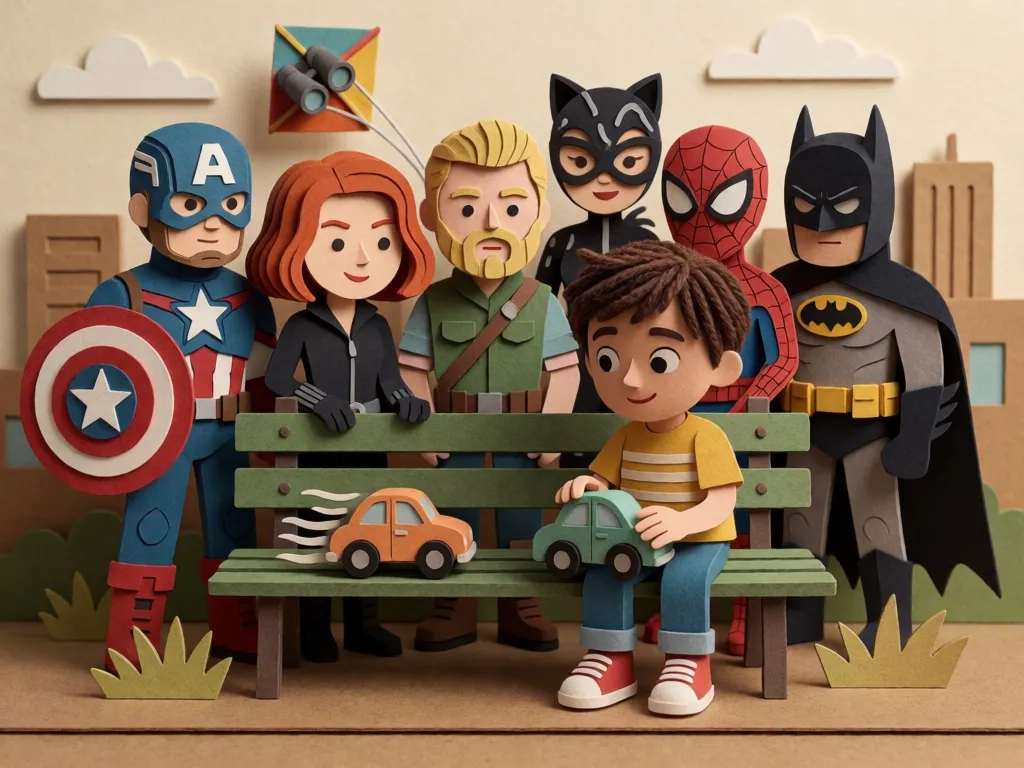
Join 9-year-old Emir, a boy with brown hair and hazel eyes, as he helps Captain America, Black Widow, Hawk Eye, and Spiderman untangle kite strings, solve a rooftop spat between Catwoman and Batman, and retrieve falling binoculars. Discover that being a hero means helping others every day!

Read children story - Emir's Hazel Hero Day!
Join Emir, a brave 9-year-old with hazel eyes, on an amazing superhero adventure! Captain America, Black Widow, Spider-Man, and Hawkeye team up when Catwoman and Batman start a backyard spat. Discover how kindness and teamwork save the day for a lost kitten!

Read children story - The Ballerina Mystery: Where Did Our Sparkles Go?
Join Lina, Derisn, and Talya, three adorable ballerinas, on a sparkling adventure! When Lina's dance shoes vanish, these 2-4 year olds must solve the mystery in a playful, simple tale of friendship and fun.
Read children story - Shurpanakha's Wobbly Wooing
A demoness wants to marry a prince! Watch Shurpanakha use funny shape-shifting tricks to win Lakshmana's heart, but learn that true beauty comes from inside. A hilarious story for ages 4-6!

Read children story - The Mystery of the Vanishing Moonbeam Berries
Join curious 10-year-old Lily as she uses scientific investigation to solve the mystery of vanishing Moonbeam Berries from Grandpa Leo's farm! This engaging story teaches observation, critical thinking, and problem-solving, inspiring young readers (6-10) to think like scientists, enjoy reading science-themed books, and apply STREAM skills to real-world puzzles.