
08 Mar 2025 · 6-minute read · MINT

The classroom buzzed with the usual pre-recess energy. Maya, a bright-eyed girl with a penchant for puzzles, and Leo, a curious boy who loved taking things apart to see how they worked, were engrossed in their own worlds. Suddenly, Ms. Appleby, their teacher, announced, "Oh dear! My collection of beautiful, hand-painted marbles has vanished!" A collective gasp filled the room. The marbles were a treasure, each one uniquely designed and representing a different country.
The class was in an uproar. Everyone suspected foul play, with accusations flying left and right. Ms. Appleby, ever the calm and collected educator, suggested a more scientific approach. "Let's use our detective skills and think like scientists," she proposed. "We'll investigate this mystery methodically."
Leo, with his love for engineering, suggested, "Perhaps we could build something to help us search!" Maya, equally enthusiastic, countered, "Or maybe we can use math to figure out where they might be!" Ms. Appleby smiled. "Excellent ideas! Teams of two, let's brainstorm and create plans!"
Maya and Leo, paired together naturally, decided to combine their talents. They began by making a detailed sketch of the classroom, noting down the placement of desks, the cupboard, and the windows. Maya suggested a grid system to divide the room into easily searchable sections. "If the marbles are somewhere in the room," she explained, "We can divide the area and search systematically, improving our chance of finding them efficiently."
Leo, meanwhile, began sketching a miniature pulley system using string, cardboard, and a small bucket attached to it. He explained, " We can use this to lift any objects we find hidden in hard-to-reach places!. This will make our search easier." This became their combined investigation tool: a grid search map and a miniature lifting device.
They started their systematic grid-based search, using their measurement skills to divide the room accurately. Using rulers and pencils, they painstakingly labeled each square on a large piece of paper depicting the classroom layout. They carefully checked each section, using the pulley system to lift rugs, check under furniture, and peek into inaccessible spots. The pulley system, although simple, proved essential—it helped them reach under the teacher's desk where they unexpectedly discovered a small, loose floorboard!
Under the floorboard, neatly nestled within a small velvet pouch, were the missing marbles. The excitement was palpable! Using the grid system, they were able to pinpoint the exact location within the room of the hiding place. They’d utilized spatial reasoning and systematic search techniques to solve the mystery. This discovery sparked a wave of joy and relief in the classroom.
But the investigation didn’t end there. Leo was curious about how the floorboard had come loose in the first place. He examined it closely, noticing some small insect tunnels and bits of wood that appeared rotten or weakened. “I think some insects have been making their home under the floorboard, weakening the wood,” he said. Using a magnifying glass, they observed the holes more closely. This led to a discussion about different types of insects and their impact on wood, a lesson in biology and environmental science.
Combining different skills and working together can lead to creative solutions and a deeper understanding of the world.
Story theme is Problem-solving and collaboration using MINT framework principles
Originally published on StoryBee. © 2026 StoryBee Inc. All rights reserved.
0 likes
The next day, Ms. Appleby, inspired by Leo’s miniature pulley system, introduced the class to simple machines. They spent the afternoon building their own levers, pulleys, and inclined planes using everyday materials like rulers, string, and plastic cups. They conducted experiments to understand how these tools amplify force and make tasks easier. They built a ramp (inclined plane) to move a heavy box, and a pulley to lift a bag of books. This hands-on experience of designing, testing and implementing solutions was fascinating for all students, especially Leo, who loved understanding how things work.
Maya, ever the mathematical enthusiast, created a fun ‘marble math’ scavenger hunt. She hid clues around the classroom, each clue requiring the solving of a simple math problem—addition, subtraction, or even some basic geometry problems—to find the next piece of information. This was a unique way of teaching math practically and applying their problem-solving skills. The children loved it!
Throughout the week, they continued to investigate other areas of STEAM learning. They planted seeds to learn about plant growth and used their math skills to measure their growth over time. They built small paper airplanes, experimenting with different wing designs to see which flew the farthest - a lesson in aerodynamics. They even used simple chemistry to conduct an experiment that showed the different densities of liquids. Each student contributed, combining their strengths to solve problems and complete their tasks efficiently and effectively. After the mystery of the marbles, a deeper learning of science, technology engineering, arts and maths took place.
The entire experience—from solving the mystery of the missing marbles to conducting science experiments and creating a fun scavenger hunt—demonstrated the power of teamwork, collaboration, critical thinking, and most importantly, the joy of learning through active participation. The experience emphasized the interconnectedness of mathematical skills and technological reasoning in solving problems efficiently and effectively, whilst enhancing their understanding in science, technology, engineering and mathematics. The students not only learned about different subjects but also developed valuable life skills, including problem-solving, collaboration, and creativity. The once daunting concepts seemed easy and attainable through teamwork and active participation.
The moral of this story is far more than finding the lost marbles. It's a lesson in combining skills - a blending of mathematics and technology to solve real problems, a belief in the power of observation and scientific inquiry, and a demonstration of how applying ingenuity and collaboration can even solve the seemingly unsolvable. At the end, everyone gained something valuable, from new knowledge to strengthened teamwork.
Read children story - The Tempest Cup of Dragon Key
When a fierce storm ruins their outdoor stage, Roo the kangaroo and his friends improvise an epic soccer play in the rain to save their meadow sanctuary.
Read children story - Pol and the Giant Polka-Dot Shell
Join little Pol and baby dino Pip on an enchanting fairy-tale adventure through pink mud and giant ferns to find their cozy treetop nest before nightfall!
Read children story - Ethan and the Moon Mountain Rescue
Join young space explorer Ethan as he races his sturdy yellow dump truck up a sandbox hill to rescue his toy dinosaur before garden sprinklers rain down!
Read children story - Kiaden and the Sovereign of the Floating Pipes
Join nimble acrobat Kiaden as he vaults across floating pipes and enchanted stone platforms to outwit Bellow-Toad and rescue the singing crown!
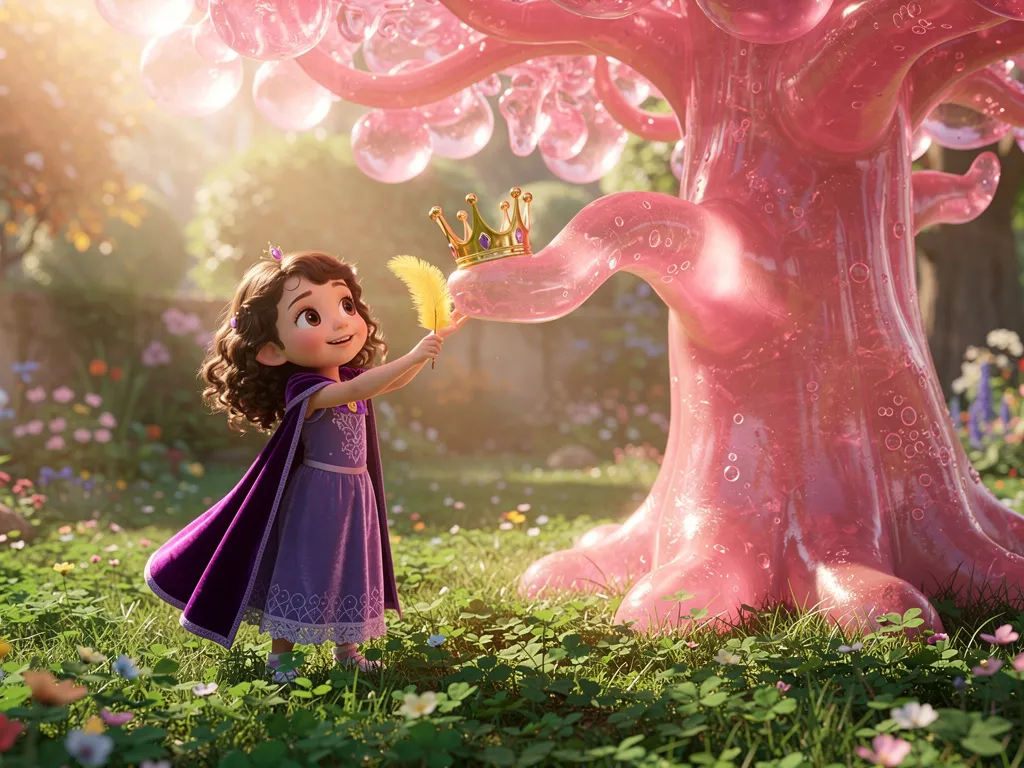
Read children story - Maya and the Wobbly Jelly Tree
When Maya's shiny golden crown gets stuck in a giggly, wobbly pink jelly tree, she must use creative thinking to retrieve it before the castle parade starts!
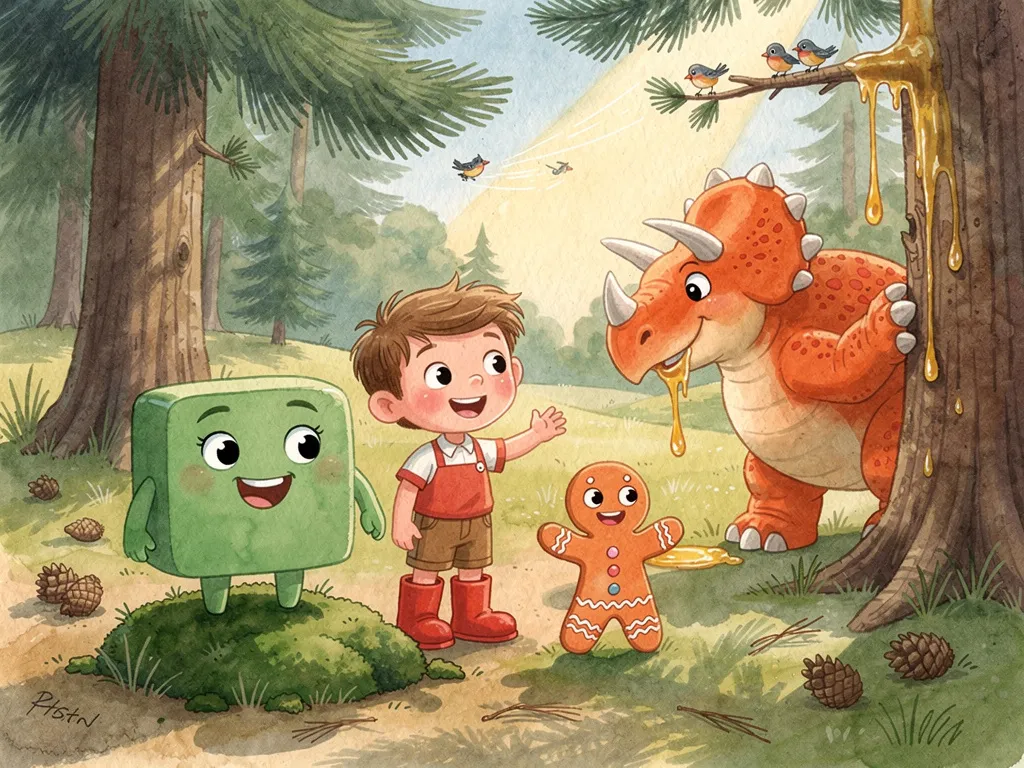
Read children story - The Big Green Pop in the Pine Park
When Gingy the gingerbread man breaks an arm, Pip, Red, and Trike find sticky pine sap to help their friend in this gentle, sweet forest nature adventure.